


Finding the Balance
Social media can harm youth mental health. An OU researcher says the key could be sticking with friends instead of followers.
University of Oklahoma social psychologist Erin Vogel gets it. Social media is a major focal point in the lives of young people. That’s just a fact and, through her research experience, she knows first-hand that you cannot pay them to put their phones down.
But her research also suggests that many young people could be happier without social media, or at least without so much mindless scrolling.

“I don’t think social media is all good or all bad,” says Vogel, an assistant professor who conducts her research for both the Department of Pediatrics at the OU College of Medicine and Oklahoma Tobacco Settlement Endowed Trust (TSET) Health Promotion Research Center at the OU Health Campus.
“It’s here to stay and it’s up to us to determine how we use it, try to maximize the benefits and minimize the risks.”
The problem is there is an ongoing mental health crisis across the United States, according to the National Mental Health Association. Young adults between ages 18 and 25 are hardest hit, with 36% suffering from some form of mental illness. Meanwhile, a U.S. Surgeon General’s advisory issued in 2023 affirmed that members of Gen Z are most susceptible to mental health crises partly because of their heavy use of platforms such as YouTube, TikTok, Snapchat and Instagram.
“Nearly every teenager in America uses social media, and yet we do not have enough evidence to conclude that it is sufficiently safe for them,” then-Surgeon General Vivek Murthy wrote in his advisory. “Our children have become unknowing participants in a decades-long experiment.”
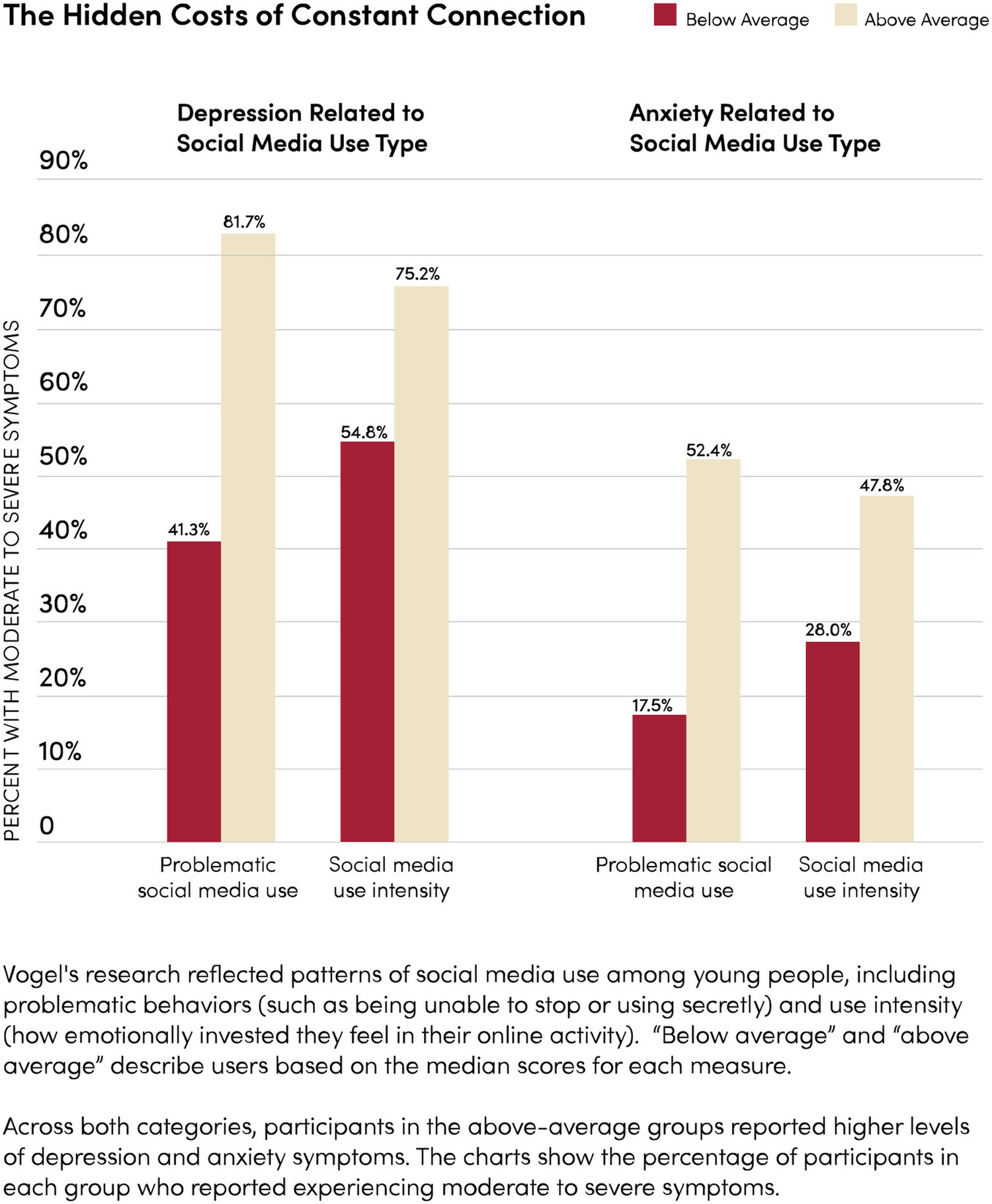
Vogel says results from a study she completed this summer involving 206 young adults ages 18 to 25 from across the nation add evidence to that argument. Her investigation found that young people who frequently engage with strangers through social media posts are more likely to have negative mental health outcomes.
Scrolling through strangers’ profiles encourages comparisons and is associated with anxiety, she says. Heavy social media use can produce behavioral characteristics similar to addiction, interfering with schoolwork, creating conflicts with parents and sparking frustration when social media isn’t accessible. Vogel saw this strong dependency during her study, when participants continued to use social media at high levels even though she offered them a small cash incentive each week to reduce their use.
“It’s similar to a behavioral addiction, like gambling, which keeps people hooked. A gambler will likely win just enough to keep hope alive and keep them coming back for more. Somebody who’s scrolling through social media is getting that same psychological reward from seeing new, attention-grabbing content,” Vogel says.
“They don’t know what’s coming next, so they keep scrolling. Getting ‘likes’ or comments on our social media posts is similarly rewarding. It tells us that people approve of us, which feels good.”
Social media also can leave users with unrealistic impressions. Viewers only see highlights and not the sum of the content creators’ actual lives.
“They see great social lives, a lot of money, vacations, whatever it may be. You’re seeing what influencers want to present to the world. It’s easy to forget that influencers’ lives aren’t as perfect as they seem.”
Vogel says her data demonstrates that young adults who frequently comment on strangers’ posts are at higher risk for depression, anxiety and stress. For example, 52% of young adults who often engaged with strangers on social media had moderate-to-severe anxiety symptoms, compared to 31% of those who rarely engaged with strangers.
She stresses that not all social media use is equally harmful. “Posting your own content and focusing on your friends, instead of strangers, may be more enjoyable and less risky,” Vogel says. “Social media can be a platform to share our thoughts and keep in touch with friends.”
Healthy use of social media comes down to being intentional and living a balanced life, she says, adding that users should focus on content that makes them happy or provides useful information from reliable sources.
Vogel says she is submitting her research results in a grant application to the National Institutes of Mental Health to hopefully fund a nationwide intervention program encouraging the healthy use of social media among youths.
“The messaging could be delivered on Instagram or other platforms to get adolescents thinking about how they can use social media in ways that are more health-promoting and beneficial,” she says. “A very simple intervention could be deployed at scale to adolescents across the country.”
Vogel hopes that one day, she’ll be able to say she helped reduce the negative effect social media can have on youth mental health.
“Everyone wants to feel like their work has a bigger impact,” Vogel says. “This is my way of trying to carve out that space and hopefully make a difference in teens’ lives.”
Chip Minty is a Norman-based writer and the principal of Minty Communications, LLC.
To comment on this story, click here.