


Keeping the Cameras Rolling
A fund named in memory of OU's 'father of film' connects students
with filmmakers around the world.
Dozens of students filed into the Sam Noble Oklahoma Museum of Natural History’s auditorium, quickly filling the front row. A few latecomers slipped quietly into seats along the back of the auditorium. Conversations stopped as the guest filmmaker—a director and writer visiting from Canada—took her place near the podium. After some brief introductions, students leaned forward, eyes fixed, as the lights dimmed and the first images lit up the screen.
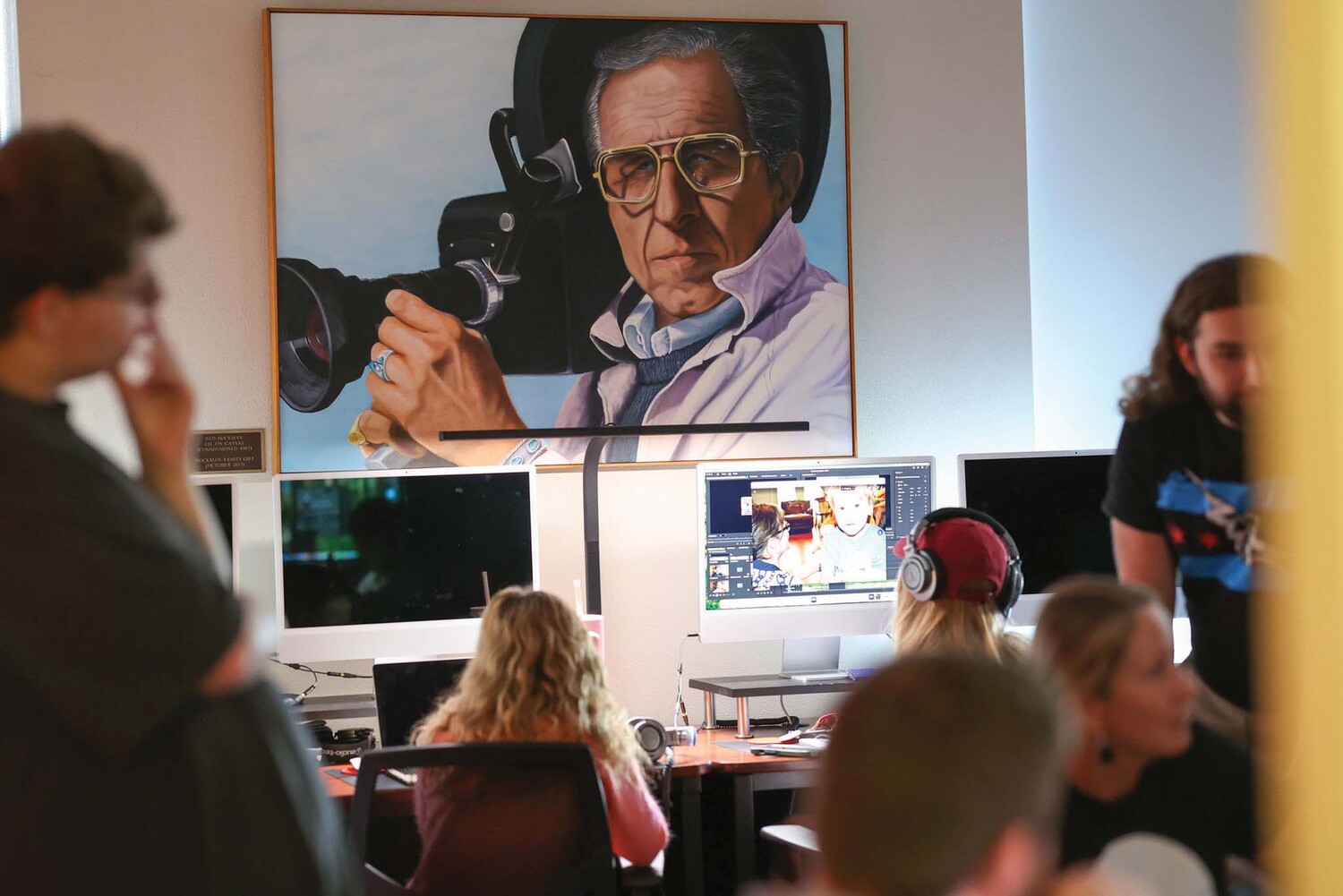
Moments like this, which widen perspectives and bring working filmmakers directly into students’ lives, exist because of the Hockman Family Filmmakers Fund, which supports the Ned Hockman Speakers Series in the Dodge Family College of Arts and Sciences Film and Media Studies department.
Established in 2024 in memory of the longtime professor Charles Nedwin “Ned” Hockman, who is widely regarded as the ‘father of film’ at the University of Oklahoma’s Gaylord College of Journalism and Mass Communication, the series brings filmmakers from around the world to share their work and spend meaningful time with OU students.
Hockman was known for his bold and encouraging teaching style, often demonstrating the standpoint that the best way to learn is by doing. This philosophy still guides OU’s Film and Media Studies program today.
His path to OU began in small-town Oklahoma, first as a teenage projectionist in a Carnegie movie theater and later as a young reporter for the Lawton Morning Press. His life accelerated quickly when he was drafted during World War II and sent to a military photography school. Soon, he was behind the camera for the U.S. Army Air Corps Motion Picture Production Unit, documenting the war from the front lines. Later, during the Korean War, he would again find himself armed with only a camera and a small handgun.

Long before OU had a formal film program, Hockman understood the power of moving images. By 1949, he had founded OU’s motion picture unit within the Extension Division with the approval of President George Lynn Cross, and over the next four decades he would shape generations of students in Gaylord College as an educator and mentor. He also filmed OU football games for more than 40 years; produced “The Bud Wilkinson Show,” the nation’s first television program hosted by a coach; and befriended longtime OU football coach Barry Switzer.
But for his daughter, Shiree Hockman Charles, the most defining part of his career happened not on the field or on film sets, but in the everyday moments when students knocked on the family’s door at all hours.
“He always had an open door,” she says. “At 11 o’clock at night, you’d hear them come into the living room with a broken camera or a film they were struggling with, and he’d sit with them for hours.”
Oftentimes, his passion for mentoring and teaching would lead to him losing track of time. Charles says her mother, Loretta Hockman, kept him organized and as close to on-schedule as possible.
“They were a team,” Charles says. “Mother was the organizer behind the man.”
Hockman turned down opportunities from Hollywood and even NASA. “Students always came first,” Charles says. “His heart was at the university, and because he knew he’d always come back there, he never left.”
He believed deeply in teaching students to be present and to trust their instincts. Charles says Hockman would tell both his children and grandchildren to go into any project like you belong there. Act like you should be in the room, and then do the work.

Hockman passed away in 2009, but his family, former students and colleagues understood that his legacy wasn’t meant to fade. Charles and her sister, Kyle Hockman Wiltse, helped establish the fund through the OU Foundation to keep their father’s passion alive and to support future storytellers.
“I remember one time Dad said, ‘Well, I guess it’ll all just wane away once I’m gone,’ ” Charles says. “I told him, ‘I rather doubt that.’ ”
She was right.
“The university held a big memorial for Daddy after he passed,” Charles says. “Students just came out of the woodwork and talked about how he changed their lives, probably in ways he never even knew.”
The Hockman fund ensures today’s students receive the same hands-on, perspective-expanding experiences that defined his teaching. The Ned Hockman Speakers Series brings in distinguished local, national and international filmmakers who spend days alongside students.
Man Fung Yip, department chair of Film and Media Studies in the Dodge Family College of Arts and Sciences, sees the series as a direct continuation of Hockman’s mission.
“He really cared about his students,” Yip says. “We hope to bring these distinguished professionals to campus so students can benefit from their presence, learn from them and, in a way, help facilitate that transition from the filmmaker’s real-world experience to something a student can apply in their own work.”

For students, the filmmakers’ visits are far more than lecture-style events. They’re immersive, creative and personal. Harrah, Okla., accounting senior William Little has attended multiple lectures in the series.
“Speakers have shared different techniques with us, but the ones that always stick with me are the ‘everything went bad, everything went terrible’ stories,” Little says.
Although Little is majoring in accounting, he has dreams of directing his own films.
“I love hearing people’s stories, and I love studying past directors and their films,” he says. “With this series, it’s in the moment, rather than learning about them after they’re gone.”
Each event in the series spans several days, typically beginning with a screening of the visitor’s work, then transitioning into workshops, class visits and small-group conversations. Many visiting filmmakers also hold office hours during which students can ask questions and seek mentorship. Some connections continue beyond campus, as students have stayed in touch with previous visiting filmmakers.
Yip hopes that, with continued support from the fund, the department can bring in more filmmakers and expand workshops each semester.
For students, such impact lingers long after the visitor’s time at OU ends.
“The series helps us to get a full, holistic look at directors and what they want to tell us as viewers,” Little says. “I love telling stories.”
And for Charles, knowing today’s students experience the kind of personal mentorship her father offered is deeply meaningful.
“He would be over the moon to know OU is continuing his dream,” she says.
Rebecca Najera is a strategic communications specialist at the OU Foundation.
To comment on this story, click here.
Editor's note: In the print version of this story, we published a photo that was misidentified as Ned Hockman. We regret this error and apologize for any confusion.