


Engineering in Action
OU's freshman engineers are designing solutions to local problems
through hands-on experiences.
Freshmen at the University of Oklahoma’s Gallogly College of Engineering are putting the cart before the horse. And these days, that’s a good thing, says Susan Walden, executive director of the college’s Engineering Pathways Program.

Walden oversees the introductory course, “Pathways to Engineering Thinking,” a requirement for each of OU’s nearly 900 freshman engineering students. The course allows freshmen to gain hands-on engineering experience with real clients, solving real-world problems long before they ever crack college textbooks on calculus, linear algebra or organic chemistry.
“Nationally, the education of engineers has gotten away from practicums until senior year capstone projects, when engineering students typically design work for a corporate client or a nonprofit organization,” Walden says. “We decided that we wanted to bookend that capstone with a similar freshman experience.”
Through Pathways to Engineering Thinking, freshmen have the chance to practice what it means to be engineers by partnering with non-profits in the surrounding community, including the Oklahoma City Zoo, Norman’s J.D. McCarty Center for Children With Developmental Disabilities and the OU Food Pantry.
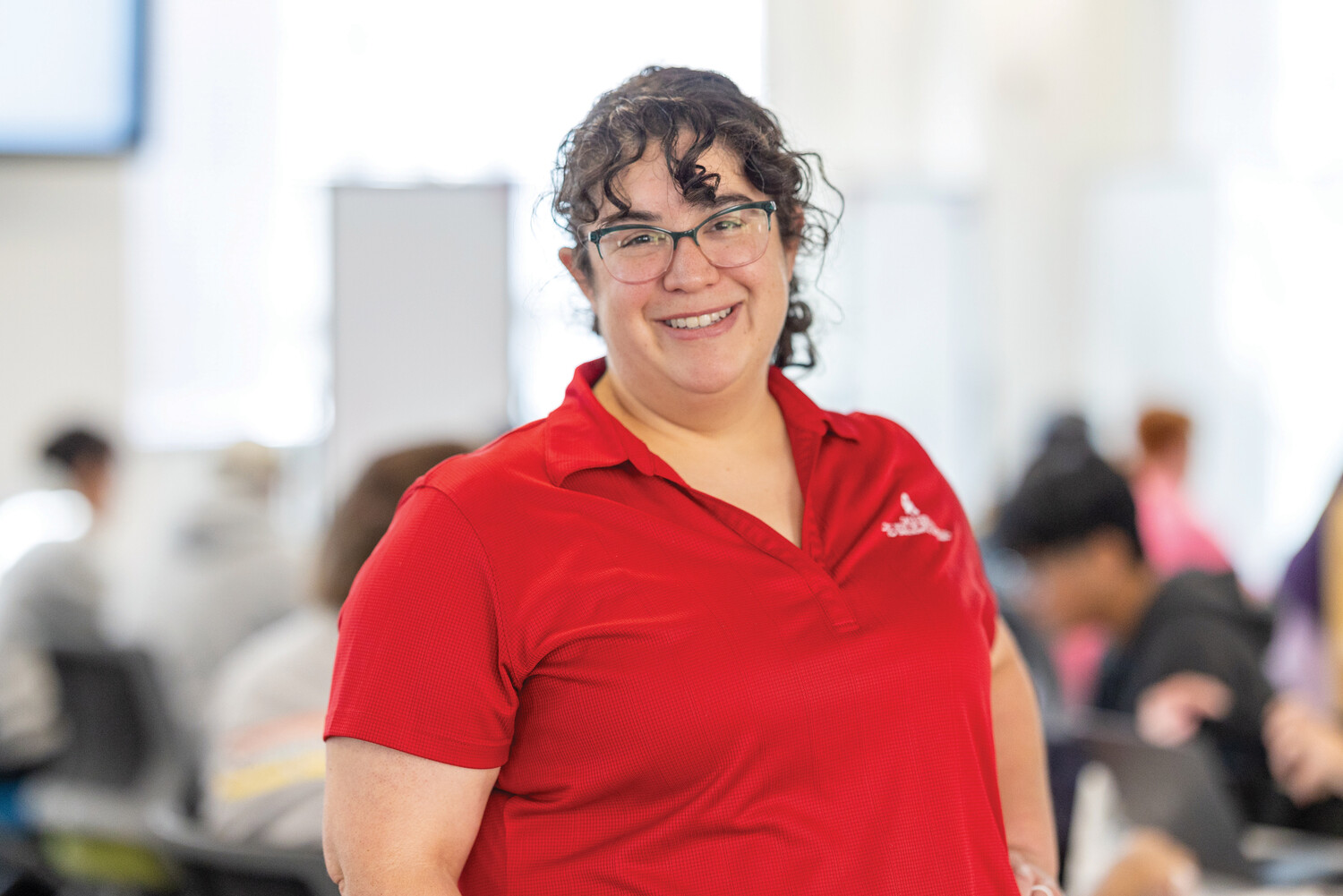
Divided into small groups, freshmen hear presentations from clients, ask questions, engineer solutions, get feedback and make revisions, which is very similar to the process engineers follow in the professional world.
For years, Walden says, Gallogly College has been dominated by students who love math, science and deep technical fields. But these days, such students aren’t the only ones studying thermodynamics and numerical methods for engineering computation.
“The number of freshmen who have never used a screwdriver is a little amazing,” she notes. “But young people who don’t see themselves as ‘nerds’ or technically skilled are choosing engineering.”
And that’s a win for Walden, who’s in charge of recruiting and retaining students to help ease a dearth of engineers in a growing Oklahoma economy starving for technical talent. She says Gallogly College’s goal is to raise its annual graduation rate to more than 1,000 bachelor’s degree recipients by 2029. That effort is changing the way OU and its students are thinking about engineering.

Walden’s team is casting a broad net, she says, and many of the freshmen they’re attracting are looking to make a tangible, positive impact on society.
“We want them to see engineering in action,” she says. One outcome of that desire has been a two-year collaboration between Pathways to Engineering Thinking students and the Oklahoma City Zoo to create toys that can help stimulate and enrich the lives of animals.
“We need a village. We need more ideas,” says Kimberly Leser, the zoo’s behavioral husbandry and welfare manager. “That’s really where I think the OU program comes in. It not only leverages the fantastic creativity of college students, but also the technical skills that they bring.”
In five semesters of working with Gallogly College students, Leser says the zoo has accumulated more than 50 custom-made items.
“I’m a little protective of the toys,” Leser confides. “I tell the caretakers, ‘You safeguard this because we only have one.’ ” They’re valuable to the animals, and we can’t purchase them because they don’t exist on the market.”
OU Assistant Professor of Engineering Allison Quiroga says students in her section of Pathways to Engineering Thinking don’t always understand their potential impact on the public. The realization hits them once community partners come into class and talk about who they are, what they do in the community and who they serve.
“The students realize that the work they do can matter and make a difference,” Quiroga says. “That’s an incredible thing for an 18- or 19-year-old to get to feel.

“The biggest thing that I’ve seen is the students try harder, they dig in more, they’re more creative, they’re more intentional and thoughtful. And in the case of the zoo projects, they really take the time to understand what it is that those animals need from us,” she says. “The level of investment is very high.”
OU mechanical engineering junior Jett Ray of Oklahoma City took Pathways to Engineering Thinking a couple of years ago and now serves in Quiroga’s class as a peer learning assistant. He says the course made him understand how much an engineering education will allow him to help others long after he leaves OU.
“These people are coming to us with a problem,” Ray says. “It’s our job to provide the solution.”
Chip Minty is a Norman-based writer and the principal of Minty Communications, LLC.
To comment on this story, click here.